
Relationship and Communication Skills Course: The Craft of Relationships.
Relationships don’t improve through good intentions alone. This program gives men the structured, practical skills to communicate clearly, resolve conflict without it escalating, and rebuild emotional connection — at their own pace, from anywhere in Australia.
Over 10 Years of Working with Men
2500+
Lives Improved
10,000+
Hours of Sessions
250+
Courses Completed
50+
Referral Organisations
Is This Course Right for You?
You still care about your relationship — but something needs to change
ou know something needs to change — but you’re not sure where to start.
Most men don’t lack commitment to their relationship. They lack a clear framework. The same arguments keep happening, the distance keeps growing, and the frustration builds — not because you don’t care, but because no one ever taught you the specific skills like communication, conflict resolution, emotional intelligence and repair processes that make the difference.
Signs this program is what you need
If any of these sound familiar, this program was built for you:
- You have the same argument over and over — and nothing ever gets resolved
- You shut down, go quiet, or walk away — and hate yourself for it afterwards
- Your partner says you're emotionally unavailable — and part of you knows they're right
- You respond with defensiveness or anger before you've even thought it through
- You want to be more present and connected — but don't know how to get there
- You've tried to change before but don't have a clear framework to follow
- You want practical skills — not open-ended therapy or vague self-help content
- You can't make regular sessions work but want a structured way to improve
- You're drifting further from your partner and want to reverse it before it's too late
- You want to understand your patterns — and actually break them
You're not a bad person — but something needs to change
What You'll Learn and Build in This Program
This program is not about talking more or trying harder. It’s about understanding the actual patterns driving your relationship problems — and building the practical skills to change them, in real situations, in real time. Six modules. Clear outcomes. A structured pathway from where you are now to where you want to be.
Understanding Your Relationship Patterns
Most communication problems, withdrawl, and recurring arguments are driven by patterns — not bad character. Through out the course you will learn how to map the specific patterns operating in your relationship: what triggers them, how they escalate, and why they keep repeating.
Emotional Availability and Connection
Emotional shutdown is one of the most common complaints men hear from their partners — and one of the least understood by men themselves. Through out the course I explain exactly what is happening psychologically and emotionally when you shut down, why it happens under certain conditions, and how to stay emotionally present even when a conversation feels threatening or overwhelming. Emotional availability for men.
Emotional Intelligence and regulation
Most men know how to communicate when things are calm. The problem is what happens under pressure — when you’re frustrated, overwhelmed, or feeling criticised. Emotional regulation is the key to constructive communication. Learn that connects emotionally and stops the cycle of escalation when things are stressed. Communication patterns under stress.
Conflict Resolution — resolving issues
Unresolved conflict is the slow erosion in most long-term relationships. It’s not the conflict itself that causes the damage — it’s the patterns that form around unresolved conflict over time. Through out the course you will learn how to de-escalate when things heat up, how to identify your specific role in the pattern, and how to have the difficult conversations that lead to actual resolution instead of another repeat. Communication Skills for Men.
Rupture and Repair — How to Reconnect After Conflict
Knowing how to repair after you’ve hurt your partner — or after conflict has damaged the trust between you — is a skill most men were never taught. Most men either over-apologise without changing anything, or wait and hope it blows over. This module gives you a clear, practical repair framework: how to take responsibility in a way that actually lands, how to reconnect without making it worse, and how to rebuild trust through behaviour that is consistent over time.
Attachment, Intimacy, and Long-Term Connection
Understanding your attachment pattern — and how it shapes your emotional reactions, your availability, and your relationship with intimacy — is often the missing piece that explains everything else. This final module connects the dots between your current patterns and your history, and gives you practical tools to build deeper connection over the long term. Not as a concept. Attachment patterns and relationships for men.
How This Course Works
A dual approach — structured learning combined with psychologist guidance
Most online relationship courses give you content to consume and leave you to figure out the rest. This program is different. A structured learning pathway combined with optional psychologist guidance.
This program uses a dual-model approach — structured self-paced learning combined with direct access to Clayton for accountability and guidance. You work through a clear framework. You don’t do it blind.
The 6-module learning pathway
The program is structured as a progressive 6-module pathway, designed to be completed over 4–6 weeks. Each module builds on the last — you’re not jumping between unrelated topics. You’re building a layered skillset that compounds as you work through it.
01
Understanding Your Relationship Patterns
Identify the habits, triggers, and relationship dynamics that keep you stuck — and learn how your patterns shape connection, conflict, and trust.
02
Communication That Actually Works
Develop practical communication skills that help you stay clear, calm, and effective when conversations become difficult.
03
Emotional Availability and Shutdown
Understand why men withdraw, shut down, or disconnect emotionally — and learn how to stay engaged without becoming overwhelmed.
04
Conflict Resolution — Breaking the Cycle
Learn how to de-escalate conflict, navigate disagreements constructively, and stop repeating the same arguments.
05
Rupture and Repair — How to Reconnect After Conflict
Build the skills needed to take responsibility, rebuild trust, and reconnect after mistakes, misunderstandings, or relationship breakdowns.
06
Attachment, Intimacy, and Long-Term Connection
Understand attachment styles, deepen emotional intimacy, and create the foundations for stronger, healthier long-term relationships.
Self-paced — but supported
Lifetime access means no deadlines, no group sessions, no fixed schedule. You work through the program at whatever pace fits your life. The structure is provided. You don’t need to come up with the framework yourself — it’s already built. Clayton is available throughout for guidance, and optional 1:1 sessions can be added at any point.
Clayton provides guidance and accountability throughout. If you need more targeted support at any point, 1:1 sessions with Clayton are available as an add-on.
Optional 1:1 sessions with Clayton
For men who want deeper, personalised support alongside the program — to work through specific situations, apply the material to your relationship directly, or add accountability — individual sessions with Clayton are available. Medicare rebates apply with a valid Mental Health Treatment Plan (MHTP) from your GP. Individual sessions with a psychologist for men.
Why This Program Is Different From a Standard Online Relationship Course
There is no shortage of relationship self-help content. Courses, books, podcasts, YouTube videos. Most of it is fine. What is rare is a program built specifically around how men actually struggle in relationships — led by a registered psychologist, grounded in evidence-based methods, and structured to produce real, measurable behavioural change. This is that program.

Led by a registered psychologist — not a generic platform
This isn’t a pre-recorded course built by an anonymous team of content creators. It’s a program designed and delivered by Clayton J Kuzma — a registered psychologist (AHPRA) with over a decade of specialised experience working with men. The methods are grounded in ACT, CBT, and IFS — evidence-based approaches that produce real change.

Built specifically for men and how men struggle in relationships
Generic relationship courses treat relationship problems as a couple’s issue and write content for a mixed audience. This program is built around how men specifically experience relationship difficulties: emotional shutdown, defensiveness, communication under pressure, conflict escalation, emotional availability, and recurring patterns that don’t respond to good intentions. Different problem. Different program

Dual-model: structured learning + live psychologist guidance
Most online courses give you videos to watch and a quiz to pass. This program combines structured self-paced content with direct access to Clayton for guidance and accountability. You’re not alone in the process.

Structured learning — not open-ended reflection
You work through a clear, progressive 6-module framework with defined skills to build at each stage. Not a journal prompt collection. Not a video library to browse at random. A structured program with clear outcomes at each module — so you know where you are, what you’re building, and what comes next.
Clayton J Kuzma
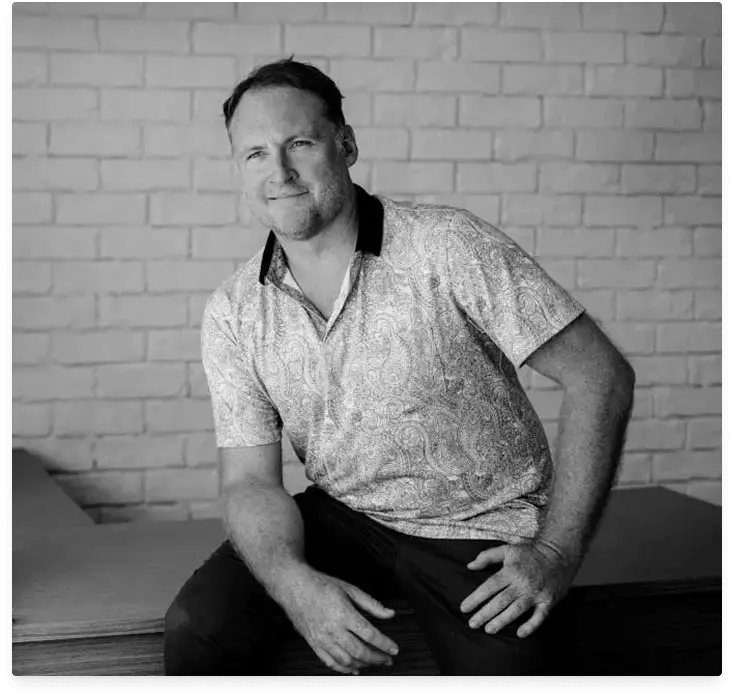
Clayton J Kuzma is a registered psychologist specialising in men’s mental health, relationships, and performance psychology. Over more than a decade working clinically, he has worked with thousands of men — from tradies and executives to athletes and fathers — navigating everything from communication breakdown and chronic conflict to emotional shutdown and relationship collapse. The Craft of Relationships program is built directly from that clinical experience.
Clayton’s approach is practical, structured, and outcome-focused. The goal is never just insight — it is the development of specific skills to think clearly under pressure, communicate effectively in difficult moments, and lead your relationship with intention. ACT, CBT, and attachment-informed methods provide the framework. Real-world application is where the change happens.
Before becoming a psychologist, Clayton worked as a tradesman and complementary health practitioner, and he brings a grounded, real-world understanding to clinical work that men respond to. He is a partner and father. He understands the gap between knowing what you should do and being able to do it when it counts — and he’s built this program to close that gap.
Credentials
- Registered Psychologist — AHPRA Registration
- Member of the Australian Psychological Society (APS)
- 10+ years specialising in men's mental health
- Trained in ACT, CBT, and IFS
What Men Report After Completing This Program
Outcomes vary depending on where you’re starting and how committed you are to applying the work. But here’s what men consistently report after completing this program:
In their relationships
- Having difficult conversations without them turning into arguments
- Partners reporting they feel heard and more connected
- Fewer cycles of shutdown, distance, and resentment
- Conflict that gets resolved — not just suppressed or repeated
- A stronger sense of emotional presence in the relationship
In how they communicate
- Saying what they actually mean — clearly and without aggression
- Staying in the conversation instead of shutting down or walking away
- Responding instead of reacting when criticism or conflict arises
- Knowing how to repair after conflict instead of hoping it blows over
- Communicating under pressure without losing ground or losing themselves

In how they see themselves
- Understanding their own patterns — and having tools to change them
- Less shame after conflict. More self-respect.
- A clear sense of what they want in their relationship — and how to build it
- Confidence that the change is sustainable, not just a temporary reset
Where This Program Is Available
Online — available anywhere in Australia
The Craft of Relationships is a fully online, self-paced program. Accessible from home, work, or anywhere with an internet connection — no group sessions, no fixed schedule, no travel required. Men across Australia can enrol and start immediately.
In-person sessions — Sunshine Coast, Queensland
Clayton is based at Maroochydore on the Sunshine Coast, Queensland. If you prefer in-person sessions — whether as a standalone or alongside the online program — those are available for men in Maroochydore, Buderim, Mooloolaba, Caloundra, Noosa, and across the Sunshine Coast.
Serving men across Queensland and beyond
Online delivery means the program is accessible for men anywhere in Australia — including Brisbane, regional Queensland, and interstate. The program content is the same regardless of where you’re based. Clayton works with men across Queensland and Australia-wide through online sessions.
Frequently Asked Questions
What is The Craft of Relationships?
The Craft of Relationships is a self-paced online relationship course for men, designed and delivered by Clayton J Kuzma, a registered psychologist. The program consists of six structured modules covering communication, emotional availability, conflict resolution, rupture and repair, and attachment — built specifically around how men experience relationship difficulties.
s this an online relationship course I can do on my own, without my partner?
Yes. This is an individual program designed for men to complete independently. You do not need your partner’s involvement or participation. The program focuses on the skills, patterns, and behavioural changes within your control — which, in practice, produces significant shifts in the relationship dynamic regardless of whether your partner is involved.
How is this different from couples therapy or couples counselling?
This is not couples therapy. It’s an individual skills-based program for men who want to improve their relationship functioning — communication, conflict resolution, emotional availability — without entering a couples counselling process. It is practical and structured, not open-ended.
How long does the program take to complete?
The program is designed to be completed over 4–6 weeks, working through one module at a time. You have lifetime access, so there are no fixed deadlines — you work at whatever pace fits your schedule. Some men move faster; others take longer. The structure supports both.
How long does the program take to complete?
Yes — when the approach fits. Research consistently supports the effectiveness of CBT, ACT, and structured psychological intervention for the issues most men deal with: anger, stress, anxiety, and relationship problems. The key is an approach that’s practical, not abstract. Men who engage consistently see real, measurable improvements.
Is this program evidence-based?
Yes. The program is grounded in Acceptance and Commitment Therapy (ACT), Cognitive Behavioural Therapy (CBT), and attachment theory — all of which have a strong evidence base for improving relationship functioning, emotional regulation, and communication. It was designed by a registered psychologist, not adapted from generic self-help content.
Can I access individual sessions with Clayton alongside the program?
Yes. Optional 1:1 sessions with Clayton are available as an add-on. If you have a Mental Health Treatment Plan (MHTP) from your GP, Medicare rebates apply to individual psychology sessions. Sessions can be in-person on the Sunshine Coast or via telehealth anywhere in Australia.
Is this program available if I'm not in Queensland or Australia?
The program is fully online and accessible from anywhere with an internet connection. Men across Australia — and internationally — can enrol and access all program content. Optional telehealth sessions with Clayton are available for men anywhere in Australia.
What if I'm not in a relationship right now — is this program still relevant?
Yes. The skills covered in this program — communication under pressure, emotional regulation, attachment awareness, conflict resolution — are applicable whether you’re in a current relationship or working on what you bring to future relationships. Many men complete the program between relationships to understand patterns they want to change.
How is this different from a generic online relationship course?
This program is built specifically for men, led by a registered psychologist with clinical expertise in men’s mental health, and grounded in evidence-based methods — not generic self-help content written for a broad audience. It is structured as a progressive learning pathway, not a video library. And it includes optional access to Clayton for direct guidance, which standard online courses do not offer.
How do I enrol in The Craft of Relationships?
You can enrol directly through the Psychology For Men website. Once enrolled, you have immediate access to all six modules and can start at any time. If you have questions before enrolling, use the enquiry form or contact the practice directly.
Start Building the Skills Your Relationship Actually Needs
Most men know their relationship could be better. Few have a structured, practical way to make it happen. The Craft of Relationships gives you exactly that — a psychologist-designed, evidence-based program built specifically for men, available now, at your own pace.
If you’re ready to stop repeating the same patterns and start building real skills — enrol today or get in touch with Clayton directly.
Not sure if this is right for you? Speak to Clayton first.
If you’d prefer to have a quick conversation before committing to anything, that’s completely fine. Reach out directly and Clayton will get back to you.
- hello@psychologyformen.com.au
- 07 5221 5842
This is a confidential enquiry. There is no obligation.
Crisis Support: If you are in crisis, please contact Lifeline on 131 114 or Beyond Blue on 1300 224 636.